
A quick google search will give you a lot of information about Saint Louis Billikens Assistant Coach Zak Boisvert. Especially if you, like him, are a self-professed “basketball nerd”.
You may have some across his old website, PickAndPop.net (unfortunately not currently live, but very useful with a search on the internet archive). Maybe an old blog where he used to post NBA clips he liked (we’ll get to this more later). Or while doing research on basketball sets to get some insight into the Billikens, you discovered that Saint Louis uses a lot of an action that Boisvert himself is credited with naming.
Well now you can add a few more pieces of knowledge to that list, courtesy of Coach Boisvert’s patience in sitting down with Sports Hub STL for an extensive Q&A:
(Questions are shortened for brevity. Coach Boisvert’s answers are edited for clarity & shortened on some)
MR: You’ve talked about your film-watching strategies & how you organize information—how has that process developed over different coaching stops?
ZB: It's changed over the years, as you work for different guys, guys have different methods and how they do it. I think what originally grew Coach Schertz and I together, is we were frankly two hoop nerds, that's how we met, we met sitting next to each other at a Boston Celtics training camp in 2015. So that's what drew us together.
So, you work for different guys, the manner in which your program will handle film will change and I really feel strong in the way we do it here, and I would say this we're very intensive and very extensive in the film we watch. Everything you do is be a little bit tailored to that.
I think feedback is the ‘Breakfast of Champions’ and I think there's so much that can be learned by, you know, there's a quote I have my office called “pain plus reflection equals progress”.
For a kid to be able to experience something and then be able to go back and review it and watch that film and be able to take those and you'd be able to walking them through some of that—there's nothing better than you walking someone through—of you seeing something and you watch an old film on it and then you seeing the kid go out and do what that is literally that is like the high—that no drug, no alcohol, no woman, can ever touch—is that.
An example was: I've been joking with Gib and Gib is such a good shooter and because of his shooting prowess so often we’ll pop and he’ll pop to the perimeter after screening and I've been on him and saying, “Hey, if you'll just mix in a roll on one of these, I don't want you to do it every time, you'll be wide open”. Two minutes in, he missed it and I said, “Man, I'm telling you, just do it.” And so in the first play of the second half I had said to the coach, “we might be able to get Gib on a roll”, and sure enough we did it. And that is the feeling—as he goes and does it—that's the stuff that's really cool.
MR: You scouted & watch Gibson a lot at your previous A10 stop—what have you learned about him this year that surprised you?
ZB: There’s some stuff that you can tell and you watch Gib play you can tell there is just so much work. There's so much preparation. There's a belief in preparation. There's no way you get to that level [without it]. There’s no secret. The work works.
So, one is that I'm not surprised.
I'm not surprised when I came here and Gibson was in the gym every single day. So that's no surprise. Some of it is it's almost too good to be true. I mean, you're talking about a kid that—obviously I'm talking about it as a guy who doesn't have a daughter but—you’re talking about a guy, you’d want to marry, you’d want to date your daughter.
He's a fierce competitor. One thing has been awesome is his belief and his buy-in has been awesome from the day Coach [Schertz] walked in. He’s been all about it and he's made strides defensively. And I really think our system helps him.
The guys at the Midtown Madness Pod, they actually have my favorite quote about it is and coach referenced it a little bit on Senior Night with him and Kobe Johnson. “It’s almost like two lovers found themselves found themselves later in life”, and I wish they had more years together because Gibb’s fit in the system couldn’t be any better. Last game he *only* had eight only had eight three-point attempts. I think that broke a seven-game streak of ten or more.
And that's really just is a perfect fit within the system, his ability to think the game and be a motion offense within himself in his constant movement, his ability to make shots off that movement, that's been really cool to see up close.
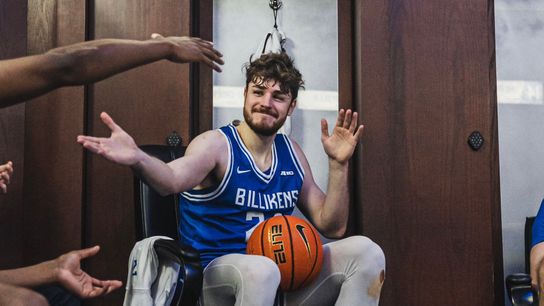
@SaintLouisMBB
Gibson Jimerson receives the game ball after setting Saint Louis single-game 3PM record with 9 vs. Loyola Chicago. March 1st, 2025
MR: Watching this team, it’s enjoyable to see those developments throughout the season.
ZB: As an assistant coach you're fighting to get in the chair, with the board and I swear the two feelings that are great is when you help a guy, maybe you see something on film, work with them on the court and then see them go do it in front of 7000 in Chaifetz, that's awesome.
And then sometimes I'll whisper something to Coach about like a play or something and if he thinks it's a good idea, he draws it up and there's no feeling better for an assistant coach than one of your ideas gets on the board and works in the game and or even better is in the moment sometimes it's very subtle, Josh will kind of point *makes a low gesture pointing back to an imaginary bench*—the paychecks are nice, that’s a cool feeling.
That's something that you spend your whole life chasing.
MR: When you lose Dotzler, and then Casey, and then Larry and then Kellen, how did the staff handle having to adapt & change the offense when so much size, handling & shooting just…disappears?
ZB: One thing I think it's so good about coach's system, and I use the word system almost hesitantly because the whole magic is the system can be tweaked, the whole system can manipulated to the strengths of the best players and coaches…that's what makes it so good is it can change and as guys emerge and as guys fault—a guy gets injured and now all of a sudden we don't have that, but now this player adds this on—so there's constant tinkering.
I think what makes Coach [Schertz] so good is he constantly keeps in mind of who our best players are, what their strengths are, how they interact with one another, what the strength of the advantage we have over the defense [are] and manipulating that to our advantage.
I'm not saying he's only one that does it. Mark Schmidt's awesome with that at St. Bonaventure. You struggle with this, he has four different ways that you will have to guard that and that's what makes him so good, but I think coach’s system is constantly malleable and it can be tinkered with and it can be adjusted to heighten, to showcase the abilities of our best players.
The amount of pick-and-rolls Robbie Avila comes off…he comes off as many pick-and-rolls as anyone else in our team—like the play I referenced where Gibson Jimerson sets a ball screen for our 6’11 center and rolls—like that's the fun stuff, and that's the stuff, the basketball laboratory and those are the different ideas that come out of that. But the ideas also are always: how do we work collectively to get a great shot for St. Louis basketball every time down?
MR: What is the game-by-game process of building those counters into the offense? What about the year-round process?
ZB: I think the secret sauce is the adjustment to the adjustment, it’s what you’re constantly thinking about. But never losing what you do well, because all of a sudden if you're trying to become tricky and you're trying to have a set trick-play for every situation, then ultimately, you gotta do what you do best.
John Cheney's (Hall of Famer who won 13 combined A10 regular seasons & tournaments at Temple) got a great line, “They might know what we're doing, they don't know how well or how fast we're gonna do it.”
The great thing about how we do things is that very little of what we do, in say in a 75-possession game, there are only a certain number of possessions that, frankly, we know what we're gonna do, because the idea is that we're going to play with flow and with concepts and be able to read and react to one another, that coach doesn't know what's gonna happen. If *he* doesn't know what's gonna happen, a defense certainly doesn't know what's gonna happen.
And I really think that's when we're our best is when guys are just thinking, they're layering triggers and they're going from one side to the next, five guys playing together, because the defense is trying to speed up and react to it and it's going on a pace that they're not comfortable with, and then constantly their decisions are being leveraged against them because oh, you're gonna run pick-and-rolls this way, or we're gonna do that, you're gonna switch off ball, we're gonna do that and that's constantly being leveraged against each other.
MR: I think fans get confused about the difference between set & flow offense—What are you referring to when you say your “flow offense”?
ZB: The way I look at it is anytime the referee touches the ball, Coach [Schertz] is gonna call something. Coach is gonna say, “Hey, this is what we're running”. Until the referee touches the ball, we would like to play at a flow and we would like to play in that read and react system.
When we talk about triggers, we're talking about things that force the defense to put two people to the basketball. So Robbie Avila post-up is a trigger for us because it forces them to make a decision. A pick-and-roll is a trigger, because it forces them, momentarily, to put two on the basketball, now they could switch it but again, it has that idea of it forces them to execute a coverage and there's different ways we can do that.
When we're at our best Coach isn’t calling something.
We’re getting stops & we’re playing with great thrusts in transition. And then we are working collectively, five guys in reading the defense and how they're playing things and reading each other and “who am I, what are my teammates?” And if that line sounds familiar it’s a Rick Majerus line, “Who am I? Who are my teammates? How are they guarding him?” That is the essence of basketball. If you can come out and play and do that, it would be awesome, if we don't have to run a single play and it's five guys reacting off one another, reacting to what the defense is doing.
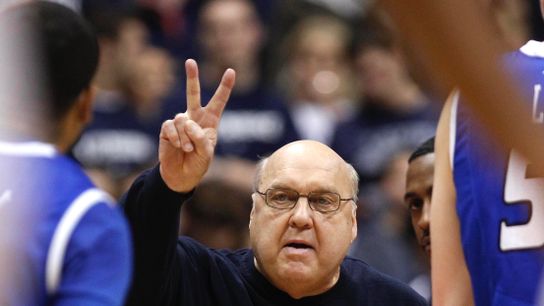
Frank Victores-Imagn Images
Jan 25, 2012; Cincinnati, OH, USA; Saint Louis Billikens head coach Rick Majerus talks to his team during a time out in the second half against the Xavier Musketeers at the Cintas Center. The Billikens defeated the Musketeers 73-68.
MR: Speaking of Rick Majerus, you’re a big fan of his, you tweet about that a lot, so what has this year meant to you?
ZB: It’s so cool.
I'm working. I'm an assistant coach in Atlantic 10.
I caught the bug being a manager in Atlantic 10, and for four years, I wiped up sweat, I filled Gatorade bottles, I packed busses, I did all that stuff.
At the time, if you had asked me, what do you want to do? At the time because it's what I knew, I said, I would do anything to be an A10 assistant.
And like, the fact that, 19 years after starting this journey, that's what I'm doing?
I remember playing down, it wasn't Enterprise center at the time, we lost a tough game Tommy Liddell took over, was a tough game in 2008. (Coach Boisvert was a team manager at his Alma mater, Fordham. He is most likely referring to the Billikens 69-65 OT W in February of the 07-08 season, in which Tommie Liddell went for 18-11-4. Off the bench.) And then we came here in 2010 and got drilled by a Rick Majerus team and stayed at the Chase Park Plaza. (He’s definitely referring to a beatdown on 1/20/10, with the Billikens taking Fordham down 75-48)
I gotta pinch myself sometimes because I'm doing truly what I absolutely love. And I hope that passion comes out and I think sometimes it comes out a fan in ways that fans get chuckle out of (we’ll come back to this moment shortly, stay tuned), but I hope that passion comes out to get to work every day, to practice every day on Rick Majerus Court, to walk Rick Majerus Court, is something that is, again, I gotta pinch myself sometimes because I think, and this is why I think Coach [Schertz] and I are so similar is, we're both guys that just love the game of basketball.
If I wasn’t a coach I'd be in a high school English teacher and I'd be coaching when ball when the bell rings. But one thing I think is so important, I think it's something that Coach talks about a lot, is there's some people that learn by only experiencing things.
They experience it and they that's how they learn.
There's some people that don't learn from experiences, they don't learn from experiences, they can't be told things and they just don't get better.
I think the real secret sauce is, yes, you can learn from a serious experience, but you can also learn from experiences of others.
And for me, my dad from an early age exposed me to basketball, and I became obsessed with it and I studied it, and I really studied, I really watched the film.
And I really read, and, Rick Majerus is a guy who I never met—I met him one time, I helped him into, he got a private locker room, he was only head coach at the Atlanta 10 who got a private room before a game. I led him into that room. It was our laundry room. It was the furnaces all over the place. That was the only time I met him, but my point is he's a mentor of mine from afar because I had a curiosity and I had a hunger for learning and he made me a better coach. I spoke to his sister last weekend, my dad bought me “My Life on a Napkin” when I was 10 or 11 years old and I read the book and I loved it, and I read it again in college.
Then when Coach got the job here and and he offered me the position, I reread the book. And what was amazing to me is, as I reread the book, I read things and I said, “oh my gosh I say that”. And frankly, it was like, I didn't realize how much of my hunger for learning, my love of coaching, my philosophy and my idea on the profession was from that book my dad got me at 10/11 years old that really it started me on the path.
I don't think I put down that book when I was 11 and said, “I want to be a college coach”, but there's a part of me that said, “man, it would be cool, it would it would be cool to be doing that for a living”, and I figured out what I love and that's basketball. I've figured out a way to get paid for it and and I don't feel like I've ever ever worked a day in my life.
ONIONS.#SLUForTheLou pic.twitter.com/kRyG8E4sPw
— Saint Louis Men's Basketball (@SaintLouisMBB) February 5, 2025
MR: One of those moments that fans had a lot of fun with was you going down when Amari dove for that loose ball in the UMass win, what was going through your mind in that moment?
ZB: That's me being an idiot and the losing myself in the passion in the game.
It's also like for me, Amari McCottry is a great example. Amari McCottry did not arrive at St. Louis as a finished product. In Amari McCottry, there's been a lot of time and not just me, Coach invested time, Anton Gray invested time, Strength coaches invested time, we pull our hair out sometimes.
I'm not gonna act like it's easy, so for me, like, we don't win that game, if Amari McCottry, who arrived at St. Louis as a very talented basketball player with zero understanding of not even a bad way, of details of making toughness plays, of paying attention to details in terms of understanding what goes into winning at the college level. And he's gotten better.
He's not a finished product. I mean the progression isn’t always linear, but for me, at that moment, to see him lay out for that ball and rip the ball from two fifth-year seniors, two guys that began in college back when Amari was in middle school, and to layout like that.
And to see that growth because frankly, he wasn't doing that on June 1 when we when he showed up here.
To see his growth, and frankly, to understand that, if he doesn't do that, we don't win.
And he does that…shovels the ball to a teammate and Swope hits a shot and we sneak out and we sneak out with the win.
So some of that's going through going through my mind there, but some of that's absolute losing myself in doing what I love because I think the best coaches, some of who they are comes out in their coaching and you have to be authentic with you. If you're not, you, be you, everyone else is taken. I really believe that. I have strengths and weaknesses, but I don't know if any one of our guys can say, “hey, Z’s not enthusiastic, he's not himself.” I I don't think they would ever accuse me of that.
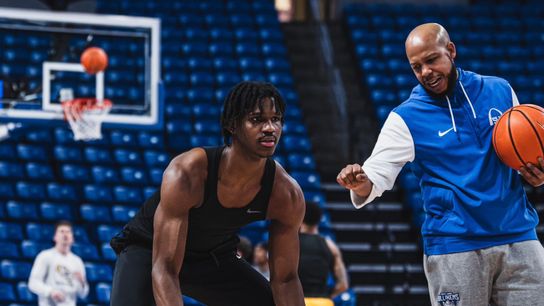
@SaintLouisMBB
Saint Louis Guard Amari McCottry works on a dribbling drill with Coach Antone Gray
MR: Has there been a conversation between you and [Coach] Phil [Gaetano] about how Amari [McCottry’s] shot doesn’t rotate?
ZB: He’s not the only freshman [with that problem] and there are some things and that's where this is a program of development.
There's some programs that have their head deep in the portal right now, and I'm not saying we're not going to be a part of the portal, but their answer is always to get better players.
For us, the first answer is get our players better. Are we constantly recruiting, trying to get better players? Certainly. But this is a program of development, this is a program where guys come in at a certain level, and it's our job to move them up, and if they're the same player a month from now, we didn't do our job.
Two months from now, a year from now—The player Amari McCottry will be because of how we do things and because of the natural talent he has and his hunger for learning, he will be, I can't wait to see what he's doing this summer. I can't wait to see what he's doing next year. I can't wait. I can’t wait.
There's also things that you're thinking constantly about—what does this guy need to do that can impact winning right now? Where do we eventually want him to get to? So for Amari, who at times there were games this year where he did not check into the game, much to some fans chagrin…So their idea was, Amari, what do you need to do to impact winning where you can be part of a rotation right now?
But then there are things: what is your growth plan?
Where do we see you getting to in the long run?
Where do we see you getting to in a year from now, two years from now, three years from now and being able to balance, and I think that's what makes our staff so good, is we can be work with Amari in the immediate of, “here's what you need to do to impact winning that we need from you in DC on Thursday night”, but then constantly there's ideas of where can we grow you into?
There are things he needs to he needs to get better at:
He needs to get better at stopping.
He needs to get better understanding advantages when he drives the ball and he's not able to get those ready-made reads of a layup or help coming.
He needs to be able to react, he needs to be able to improve as an outside shooter.
He needs to be able to shoot better off the dribble.
There's things that he needs to get better at and the constant idea is that constant learning being able to balance and being able to live in two time lines.
What do we need to do right now?
What do we what do we ultimately, where do we want to get to?
And I think that's where we separate ourselves with player development.
I think that's a buzzword that's used a lot in coaching, college basketball, and I think we live it every day.
You saw it in here today, even before practice, guys were getting a 30 minute individual in every day. No coach wins without great players. Whoever wins that, whoever is standing on Sunday on the podium…didn't do it on his own..he did it with great players.
I think where Coach [Schertz] has separated himself is he's been able to recruit really good players, [but] he’s been able to get them better as they went.
Sometimes that guy needs skill improvement.
Sometimes he needs physical improvement. He needs to get stronger.
Sometimes it's him understanding the mental component of the game and understanding the knowledge and how that can impact the game.
Really the secret sauce is when you can combine all those things and they're all spokes on the wheel, all those things are combining to make guys better players.
I think developing players is one thing that Coach does at a super high level over and over again
MR: From where did the development of Kalu’s bounce pass on the dribble hand off originate?
ZB: It's so cool because it's something…Robbie Avila does very well. He does that naturally very well.
So I remember Rob, and this is the coolest thing is when you have peer-to-peer learning and that's what's special, because I'll say this, I can talk to Kalu about it and I remember Phil Getano and I talking to Kalu about it in and working with him on it. But Robbie is as good as anyone in the country at that play, him doing it, one, carries more weight, but two, he's out there when the bullets are flying at him, articulating that to Kalu is so much more powerful than me.
But I remember being on that on that end of the floor *points to the far end of the Chaifetz Pavilion south court* and watching Robbie talk to Kalu and saying, “no, just drop it off”. He's like, “what if he's trailing him?”
So the first person I saw do it is was Joel Embiid doing it with JJ Redick, where the whole idea and it's constantly the game evolving and these small things of evolving. JJ Redick and Joel Embiid had a really good dribble hand off combination, but teams were trying to blow it up.
So Joel Embiid just started dropping it behind him and JJ Reddick would chase it down. At a certain point, like if you try to shovel that ball, the defense gets inside it, but there's a moment where if there's an advantage, you can drop that ball behind you and trust that player run behind. Because there’s certainly trust.
So [Kalu’s] dropping that ball behind him. He's trusting Gib to fly off it. But I can look down and I can close my eyes and picture Robbie talking to Kalu about it. I can also look over 15 years of coaching, I have a folder and there's a video on it, we’ll call it drop pass, and I remember sending it to Kalu saying, “hey, this is some of what we worked on today.” And it's been really cool seeing Kalu take it and run with it. He’s had as many of those as Robbie in the last five, six games. Cool to see.
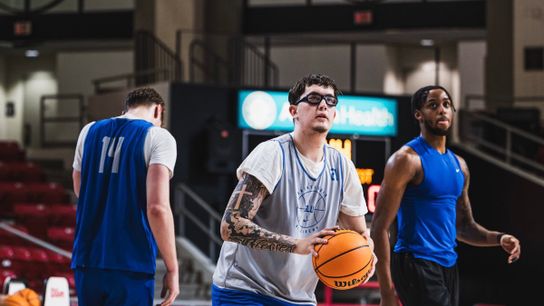
@SaintLouisMBB
Robbie Avila (center), Kalu Anya (right) & Killian Brockhoff (left) shoot around before a Saint Louis away game
MR: Is there an action/play in the NBA or CBB that you’re enamored with right now?
ZB: I'll give you a fun one that I'm obsessed with and it’s so fun to see—the transition dribble pitch Swope has started doing with Robbie Avila over the last five games.
I don't know when it started and they just started doing it and it's become two or three times a game, Robbie Avila, who at one point was having trouble getting threes off because of how defenses were playing in the constant chess match, putting smaller guys on him, we’re trying to figure out ways to get him threes and we try to figure out different ways to do that.
And it's so fun that, I'd be lying to you if that was anything other than Isaiah Swope and Rob coming in, just figuring it out on their own a little bit.
And that's where because of how much how much we play in practice and how much five-on-five we play, because what creates these really fun, really creative instinctive plays, it doesn't come out of drills, it comes out of letting your guys play five-on-five and and and coaching them through it, not just rolling the balls out, you'll be amazed at what come what comes out of that.
It's really cool. One thing that's awesome being in this league is, and I've been in it now at three different programs and the coaches that I've been able to study…are amazing.
You look in the league right now—Ryan Odom, what he's done at VCU. It's so cool with Ryan Odom. I coached against him when he was at UMBC. I studied his teams at Utah State and I studied his teams at VCU and obviously competed against the teams at VCU. He's won three different ways. And frankly, Coach [Schertz] played against him at Lenoir-Rhyne, he won a fourth different way there.
Mark Schmidt has more—Mark Schmidt's play card, it looks like the menu at a Greek diner down the street that has everything on the menu.
Billy Lange is an incredible offensive coach.
Chris Mooney, again talking about a guy that's one different ways, and Chris Mooney was the head coach when I was a manager in the league. He's won in different ways. He's souped up his Princeton offense and they’re playing faster. So that's the cool thing you're able to do.
I love what Drew Valentine does and that he's able to run the same thing, run the same action, but make it look different, but then he's also able to make everything look the same, but be able to do different things out of it. So I'll explain that a little bit.
He can run four different things out of the same alignment or if he thinks you're struggling with an action, he can get to that same action but he'll start four different ways.
That is really cool.
And that is really hard as an assistant coach who has that scout, that's really hard to diagnose because they get in slime and they run four different things.
All right, we're struggling guarding this it's not as easy to tell your players, “He's going to start here, he's going to start there”. No, because if you're struggling with this act, if you're struggling with guarding a double side pick-and-roll, Drew Valentine's got six different ways to get into it and that's really impressive to me, so that's something I'm studying right now.
~~~Coach Boisvert messaged me after the interview to clarify all of that with a shorter phrase, “We want the same things to look different and the different things to look the same”.~~~
Coach Jason Fang and I have a group chat we're constantly throwing out ideas of just different things we're seeing, in the NBA and Europe and different levels of college, guys we are watching.. that's where the hunger and the growth and the hunger for learning comes into play.
MR: How do you balance the way concepts change and evolves vs staying the same over the years?
ZB: That’s what is great working for Coach [Schertz], I'm biased, of course, but I mean, I think he he has an understanding of coaching and understanding of offensive and defensive basketball level that's so high and…the right idea will win and he's constantly looking, is there a better way to do this? Can we do this a different way?
And that why I love working here, because this place is an incubator for basketball knowledge and it's a heaven for a basketball psycho like myself, because every day, I mean, even like the cool stuff you do, we finish practice every day with a flow scrimmage.
He gives me blue every day, he takes gray, he's got the good team, he’s got the top group. But every day, I get to coach kids I love, standing on Rick Majerus Court, making very good money, coaching, matching wits, coaching against, I think, a guy who's as good of a basketball coach as there as in the world.
[Takes a moment]
Yeah, stuff that, like, I'm still waiting for someone to come tap me on the shoulder being like, “Hey, time's up, buddy. You gotta go back to the real world.”
So that's really cool to me, and I know that's corny and zen but it's something that I love doing, so I try not to lose side of that, and I try to be grateful for that.
@SaintLouisMBB
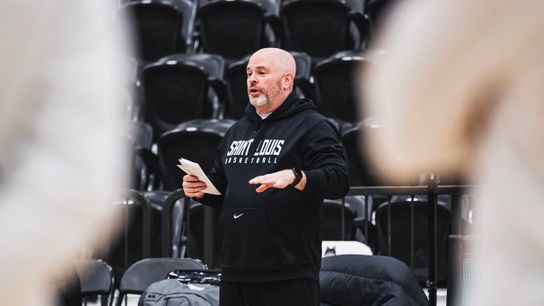
Saint Louis Billikens HC Josh Schertz runs a drill at practice in Chaifetz Arena
MR: I appreciate you & Coach Schertz indulging basketball nerds in St. Louis—
ZB: I actually told a young coach this yesterday, I said, “if I were you anytime, any transcript of any video of a Josh Schertz conference, I would listen to”, because he doesn't short change you guys a bit. He does not.
He does not speak down to the audience.
I mean, he is like almost to the point where, like sometimes like I'll hear him talking. I'll be like, gosh, I actually know a couple of the assistants in the league will listen to his press conference because he will give you, like there there are pearls of wisdom he will give out because he's not afraid.
He respects your profession, he respects the fans and he doesn't want to short change and honestly I think it's really cool because I think I've seen coaches that kind of blow past and just will kind of talk to you like you're, you know, he doesn't short change it at all.
MR: The time he explained topside tagging during a midweek availability & it completely went against most conventional NBA talking points of the last decade—moments like that have been fun for Billiken/basketball fans.
ZB: Ryan Odom at VCU is the best example. VCU is the best transition defense of the league and the best at offensive rebounding. It goes hand in hand, because one is they play in transition because they're constantly getting those rebounds, but also two things will happen.
Sometimes they're not getting the rebound, but the ball's tipped and all of a sudden, it takes away the transition, the thrust.
And then sometimes teams are so hesitant to run because they're worried about the offensive rebound. I mean, he's a great example of that.
But some of that, too, is that nothing is original underneath the sun because while we're lauding NBA teams for topside tagging, understand, I have a book in my office written by Pete Newell, written in the early 1970s and he's not using the word topside tagging, but he is saying, your offensive rebounding—he called it OBC, offensive board coverage—your offensive board coverage, your offense rebounding plan helps your transition defense by you going to the offense glass helps you get back.
So that's what's fun is there's nothing original under the sun.
Nothing’s been invented in this game since Bob Knight sat down on Pete Newel’s living room floor and invented the motion office.
There's not one thing. Everything's a creation of, it's just a twist on something else and if you think you figured something out, it's somewhere on tape, somewhere else, someone doing it.
MR: The flow side of basketball and that idea of the cyclical evolution of the game to be one of the best parts about basketball.
ZB: Are you a football fan?
There’s a great book called “Blood, Sweat & Chalk” by Tim Leyden, who used to work for Sports Illustrated.
Really what it does is it tries to study the different evolutions of the game of football, so each chapter is on a different thing: Where did the Air Raid start? Where did the triple option start? It's really cool and you watch it build upon itself.
And that's what I love about basketball a version of that is like what you describing I would be shocked at you not absolutely loving that.
MR: There are coaching videos of Greg Popovich hammering home “never switch” in the early aughts. 15 years later he wins a championship at the forefront of switching defenses.
ZB: He comes up with that switching scheme—and this is what’s great with all these layers—that's since been replicated all over NBA, he does that because there's a team out west (Golden State), who's playing a completely different way involving threes, because they're playing a different way, all of a sudden Greg Popovich needs to tweak what he does, and then it's just this cycle that in that's cool see, and it's cool to see that butterfly effect and it splits and plays itself out
MR: Then you have to go back to Thibodeau as the defensive coordinator for the Celtics & his weak-side help scheme and how that comes from making zone defense legal again.
ZB: You also gotta think about that line right there that made those shots behind that line, worth 150% more than that, and then people ultimately getting to understand, “Hey, that is a pretty significant percentage difference”, and really taking it and running with it.
MR: And then everyone adds shooting. And then the bigger players get better at shooting and everything is position-less. And now you get players like Robbie & Jokic who can/will do whatever to just get the ball in the hoop.
ZB: It’s what makes basketball so good is there's this creative expression.
Football is so learned, you five guys are lined up there and you actually can't touch the ball, you guys can, but you guys need to start being on the line, you need to be as far as—basketball, it’s just this freedom expression.
There's this flow state that exists within basketball that's so fun and you have these guys who are six-foot-11 and are brilliant passers and can handle the basketball, and, they're not the quickest afoot, but their mind is so good, and you have Gibson Jimerson who will fly around the corner and stop on a dime *claps hands* and pull up, and you have Isaiah swope, who is so quick, he has there micro bursts of quickness and he can shoot on stuff right away off the dribble and he can you can do all these things. You have Kalu Anya who plays with so much force and he's constantly thinking about how can I leverage what the defense doing against me to help these teammates and like, that's really cool. And you have a guy like Kobe Johnson, who's just all about winning…and saying whatever we need to do to where St. Louis has more points than other team, I’m in.
That's really cool and you have the individual expression that comes out is special.
@SaintLouisMBB
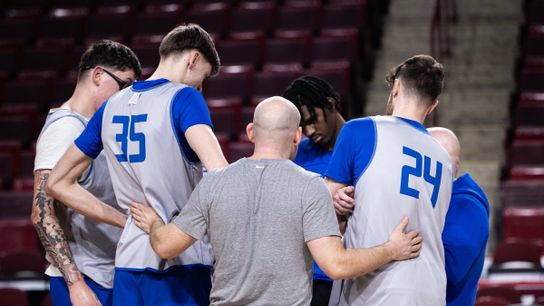
Saint Louis Billikens Assistant Coach Zak Boisvert join the huddle during a practice at Chaifetz Arena